7/20/2013

Import Shop


If you can't see the video, please go here: http://youtu.be/BqPjVhszfNo 

When you've been in Japan for a while, or if you spend a lot of time cooking, you may find yourself craving some of the ingredients from back home, some of those things that Japan just doesn't have. You'll be very surprised at a Japanese person's reaction to beans on toast, for example. Don't despair at the differences though. There is an answer, and no, it's not smuggling canned goods back into the country or having your mum post you suspicious looking packages of baking flour. Go to the import shop!

The import shop is not a building that has been carried over from another country 'Up' stylee. No, it is in fact, a shop that is full of imports, much like a paper factory isn't made of paper either. Crazy, I know.

Inside, you can find allsorts of things. A lot of them will be from your home country, but most of them will be from other countries because, as much as it may shock Americans especially to hear this, there are other countries out there. Did you think you had just wandered into Chinatown or something? Take a look at our video above to see exactly what one import shop in Sendai has for sale, but rest assured that if you want something, you can probably find it there.

It's actually a very good place for cross cultural communication. For example, when I was growing up I loved Pez. However, they stopped selling them in the UK long ago and so I wasn't able to get any for quite a while (though I did have some willing American friends who sent me a few). Now, in Japan, I can go to the import shop and get plenty of Pez, though they are usually Disney, Hello Kitty or Thomas the Tank Engine for some reason. I'm still searching for that monkey pez. Hint, super strong hint. So it allows us to get items from other countries. Great for lovers of real Indian curry, mexican food and gravy!

There are two main import chain stores in Japan. The first is Jupiter, shown in the video. They have a lot of snacks, sweets and cooking ingredients. The other chain is Kaldei Coffee, which, wouldn't you know it, have a large selection of coffee. They also do gift wrapped selections for special holidays and events, and you can have a free cup of coffee to drink as you wander around the store. I often wander around just to get the free coffee, and I don't even like coffee!

So, don't worry too much. If you are craving something in Japan, you can get it from the right place, but it might be a little more expensive. Don't buy regular Japanese stuff here!  I also still recommend that you bring as much toothpaste and deodorant from home as you can. Those are terribly weak in Japan.

4/26/2013

Cherry Blossom Viewing Party (Hanami 花見)


If you can't see the video, go here: http://youtu.be/xZzSoYvbz38 

Sakura, or cherry blossom, is one of the most iconic images of Japan. It's such a big part of their culture that they have parties about it like we westerners celebrate New Years. Why is it such a big deal?


  • Its beautiful: Just look at it. Petals of soft, creamy pink are just so lovely and rarely seen in nature. So why not celebrate it? It's beauty is emphasized even more by the fact that its appearance is fleeting. The Sakura blooms for a week or two in spring and then its gone....Just dust in the wind, dude. Dust. Wind. Dude.


  • It's mysterious: Old folklore tells of how the Japanese version of Romeo and Juliet died and were buried under a white blossom tree, but the tree took up their blood and became a pink color. Is this strange vampire plant really the origin of the beloved blossom or is it just the romantic tale that pulls at people's hearts? Because a lot of people would have had to die with seeds to make all these cherry blossoms.


  • It's Japanese: If there is one thing that is guaranteed to make a Japanese person like something, then its it being Japanese. Seriously. Japan is one of the few countries where imported food is cheaper because Japanese will pay more for their own products. The Japanese have certainly made the Sakura their national symbol. No where else will you find so many cherry blossoms and they will tell you that at any given opportunity.


The Party

When the Sakura comes out people flock to every park, river and locale to have their Hanami. 'Hana' means "flower" and 'mi' is "look" so it is a flower viewing party. Essentially it is a picnic. And a great excuse to get drunk. Friends and families, students and teachers, workmates and companies, they will all arrange a Hanami and enjoy eating and drinking under the pink blossom. A common sight there is the blue plastic mat. People reserve their spot hours, perhaps days in advance by putting down their blue sheet for their party. Often junior members of companies, or whatever group, are chosen to do this because no one likes waiting around for so long and they are at their bosses' mercy. When it finally comes though, its a lot of fun and not quiet at all. In fact, you have to wonder if people are looking at the flowers because so much attention is paid to the food preparation, so much drink is had and often there is live music or music playing through a tannoy. It's a full on party. I mean, party on, dudes.


Of course, such activity is dependent on the weather, and it is notoriously unpredictable this time of year, especially lately. So many people have eyes on the weather reports, which also offer a forecast of expected dates for the cherry blossoms to bloom in different regions of Japan. It begins in the west of Japan (Fukuoka, Hiroshima) around the end of March, early April, and then the wave of pink moves across the country, hitting the far north of Hokkaido in May. Here in Sendai we get the cherry blossoms in the middle of April and so the Sakura Panda Tea Time crew headed out to our local park to join in the festivities.

It's a great tradition, one that people fight to take part in around work or school commitments. It's also a great bonding experience for friends, as who doesn't love a party or a picnic or nature... Or pink?! Or bananas? I can't guarantee bananas, but sometimes..... 

3/24/2013

The Hundred Yen Store

If you can't see the video above, please go here: http://youtu.be/2yGp9hsp-ac

What can I say about this blog entry that hasn't already been said? Well, pretty much everything, because I haven't said anything yet. All I need to say is very short though. If you come to Japan and there is something you need to buy, go to the hundred yen store. I'm not even going to ask you what it is you want. Just go.

The hundred yen store, as you can see in the video, has pretty much everything. Okay, they have been short of nuclear powered time-travelling robot maids suspiciously often, but you will not believe the range of goods this shop sells. Everything from snacks and ready meals, to party hats and money tins, from garden hoes  and pet collars, to stationary and kitchen cleaners, it's there.

Now you might think that not every hundred yen store is as big as the one we explore in the video, and you would be right, but don't worry because even the smallest store has an amazing variety of goodies. In terms of storage, it's as close as we'll get to Doraemon's 4th dimensional pocket for at least a century. 

You might also be thinking that all the bargain store goods are cheap rubbish. Fear not. Although there is undoubtedly better quality goods from a brand store or specialist, the quality of these items is well beyond what a layman might need. It is also well beyond the (frankly speaking) shitty bargain stores in the west.

As such, the hundred yen store is the perfect place to go when you first move to Japan. It will have everything you need to furnish your home at a reasonable price and will save you a lot of time, energy and money. Of course, if you stay in Japan and explore your city, you will find better specialised stores with their own bargains and advantages, but until you have that time, 100 yen store it is! I visited there almost every day when I first came here and I still go there often when there is a little household knick knack I need or a cheap prize for students.

Have you ever been to a 100 yen store? What's the strangest thing you saw there?

2/25/2013

Japanese style bars / pubs: Izakaya


If you can't see the video, go here: http://youtu.be/pe0EMLeYH1I

This topic wasn't on our schedule, but we found ourselves in an Izakaya on a quiet night and Nat said "Hey, we could make a video now". So we did. And there was much rejoicing. 

So what is an Izakaya? In short, it's the main, traditional watering holes in Japan. This country has a lot of bars and I'd be more surprised than an aeroplane pilot who finds a bunny in his headlights if you can go to a Japanese city and not find a British themed or styled pub. You might even find one that's a major gaijin (foreigner) hangout and make some new friends... or run from new enemies. You know, whatever your social circle. So, yes, Japanese folk can drink like the rest of us... well, at least they have the opportunity. However, it is a borrowed Western idea, just like McDonald's (except beer actually improves your health), just like baseball, just like some other cool similie I can't think of right now. Don't judge me! 


Izakaya are the true Japanese style establishments that primarily exist to ply the customers with alcohol just as long as they ply the owners with money. So, in it's basic principal it is also the same. However, there are many differences. So here they are in handy list format:

  • Greetings and shoes: Don't be surprised if the waitresses bow and greet you at the door and then ask you to take off your shoes. If they don't take your shoes at the door then they will probably ask you to when you enter the private room.
  • Private rooms: You can sit at a counter in some places (it is cheaper) and you can sit at an open table if you like, just like a regular restaurant, but Izakaya also have private areas marked out by sliding doors and in here you are in your own little drinking world. Have a look at our video to see how it works. The awesome thing is the staff can move the walls and doors around to make different sized rooms based on requirements. Confuses the hell out of drunk foreigners.
  • Food: At most, in the west, we would scoff some crisps, nuts or mini-pizzas (in those posh gaffs), but Izakaya are very close to being restaurants. They offer a full menu and often a huge variety. Though some may specialize in certain types of food. You'll have to shop around to find one with a menu you like, but be adventurous. There are some strange but fantastic foods. I swear once I picked stuff at random and I got fresh baby squid on ice. Of course they have normal food too. Also, because Japanese think it is bad to drink on an empty stomach, you will be forced to accept a small dish of snacks on your arrival, along with your towel. This is not free! But you can't refuse it either. Otherwise ninjas jump out of the walls and take you away.... no one knows what happens next.... 
  • Drinks: They have all the usual and all the types of Japanese drinks such as sake (rice wine), shochu (potato or rice spirit), umeshu (plum wine). 
  • Towel: Wipe your hands! Wipe them!
  • Cute slave: The waitress is at the mercy of you and your magic summoning button all night. Use it wisely, and be nice to the girl. She has to put up with a lot.
  • Sharing: The western man's drink time snack is his treasure, take it without permission and be at the wrath of his insatiable drunken cravings. However, in an Izakaya, the idea is to share. Some dishes will be very small and compliment one another. Others, like the chips (french fries - see the video) will be very large and meant to be shared. The idea is that people order bits of whatever they like and then you sample a different set of whatever you like on the table, while you are chatting, singing, dancing and insulting a fellow gaijin's home country and choice in women. Or something. 

So now I have tempted you, how do you find them? Well, like I said, they are everywhere. If you can find any building with bars and restaurants in it, there will be an Izakaya but it can be hard to tell exactly which is which. You could keep an eye out for the kanji that says Izakaya (居酒屋).

The easiest way however, is to let someone show you. Around any meal time that isn't breakfast, but especially at night, there will be plenty of people in Izakaya uniform (or super thick winter coats, if it is winter) carrying a menu. As you walk near them they will shove the menu in your path and spout a sales pitch. That's your cue! Nod enthusiastically! Speak to them if you can. They work for the Izakaya and they will take you to their restaurant. If you want a certain something or you see something on their menu, tell the worker and they will likely call it down to the Izakaya on a secret radio and warn the others you are coming. They will probably show you to an elevator if it isn't on the ground floor, and then you can laugh as the same person sees you off and then runs all the way up (or down) the steps to greet you when you get off the elevator and show you inside. They do that sometimes. It depends how many workers there are. Feel free to discuss deals and special offers with these people. It is their job to entice people inside, and that is often why they will be girls. 

There is another type of person who wanders the street at night, looking for customers, and that is not an Izakaya worker, but karaoke. You can usually tell them apart as the karaoke name will be branded on their clothing. 

So that's it! Take some friends, have a party, enjoy your Izakaya!

Have you ever been to one? What was the strangest or most amazing food you ate there?


2/17/2013

Chinese New Year: How to Make Gyoza (dumplings)!


If you can't see the video, then please go here: http://youtu.be/-ev-gmaOKxk

I know normally we are focussed on Japan, but we can't miss talking about an important event to Chinese people. In today's blog we'll talk about the Chinese New Year ! The Chinese New Year is different from the western calendar ! The date of the Chinese new year may occur anywhere form January 21st to February 21st, as it falls on the second new moon after the winter solstice. New year is important, but the happiest day is the new year 's eve ! Chinese make long preparations for the new year: shopping, cleaning house etc.

There's a lot of traditional things we must remember : 

  • Must have a total bath before the new year 

Because the new year is new start everything must be new, fresh body, new clothes, new age! And as tradition goes, bathing in any form on the day of Chinese New Year is considered bad luck because one would be washing away the good luck that has been bestowed and whisked upon them for the new year.

  • Can't cut your hair during the new year until next month (if you have maternal uncle )

Haircuts are received before the new year begins since it is thought cutting hair during the first lunar month of the year places a curse on maternal uncles. Therefore, people get a haircut before the New Year's Eve.

  • All doors and windows must be open and all light must be turn on New Year's Eve 

Open the doors and windows is to allow the old year to escape. Turn on the lights just for allow the good luck of the new year to enter.

  • Setting  off firecrackers on New Year's Eve 

Do that is scares away evil spirits while sending out the old year and welcoming the new one.

  • Knives and scissors forbidden 

Knives and scissors may not be used because they may cut off fortune.

  • Wear red (avoid clothes in black and white )

Celebrants wear red to scare away evil spirits and bad fortune and ensure a bright future.

There you go! I hope you had a happy Chinese New Year and that you can celebrate it properly from now on. Check out our video for full details on how to cook real Chinese dumplings; gyoza (in Japanese)! There is even a vegetarian option, since Matt is vegetarian too!

Have you ever had gyoza before? Do you prefer them fried or boiled? Please let us know too if you try to cook them and how they turn out!  

2/02/2013

What can you buy in Japanese convenience stores?


If you can't see the video, go here: http://youtu.be/6Wa94Rpslpo

A convenience store is probably the second or third building you will go into when you arrive in Japan. The first being the airport, the second possibly a hostel or hotel, just incase you wanted to test me. They are everywhere, so you won't have any trouble finding them, and they are reasonably priced - though a little more expensive than the shops that will end up being your locals if you stay here. The other benefit is they sell pretty much everything, and there are a few other things you can do there that you might be surprised to hear.

Before I reel off a list that will drop your jaw faster than a naked supermodel, I just want to say that we are not endorsed nor do we support any particular brand, we are just providing information of services available. However, if any convenience company wants to give us money please get in touch we'll be glad to alleviate you of cash for advertising. Also, if any of these "surprising things" are no longer surprising because you have them in America now, or whatever, then I apologise but they don't as far as I know, and didn't when I was there. 

The video above shows just about everything that is in the store, but let me list the essentials. In a Japanese convenience store you can: 

  • Buy Food: Kinda obvious, but it's true. You can buy snack foods from potato chips to dried squid, ice cream to frozen chips, rice balls to fresh fruit. There's prepared meals which just need a minute in the microwave to get you going (they will even ask you if you want it heated in store). There's sweets like chocolates and super sour fruit gums, but be careful because the packets are very small. They also have fried food like hot dogs and meat buns (nikuman) kept warm in a glass case that is possibly fuelled by the burning souls of disrespectful customers, but Japan is pretty short of those so I guess not. 

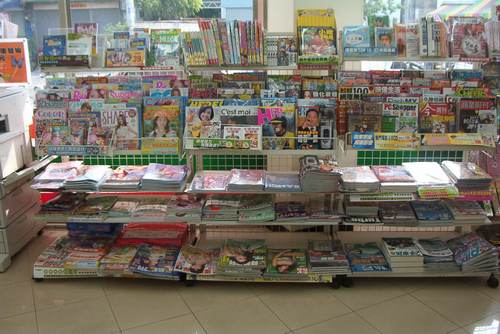
  • Read comics and magazines for free: A convenience store is like a library. People go in there and flick through the magazines, read all the comics and then leave. They sell all sorts too. From kids manga and puzzles to study books, style mags to young adult manga complete with bikini model shots and no holds barred porn. It's all right on the shelf on the same level with a wide range of fetishes, real women and cartoon... not that I know anything about that, but if you can't find what you want, check on the shelf under the main displays. They have even more there. Ahem. 
  • Buy seasonal gear: Depending on the current time of year, convenience stores will have a small section devoted to surviving. In winter they sell cheap hats, gloves, scarves and pocket heaters. In  summer they sell hand fans, folding fans, cooling gel and other things to get through the heat. It can be good, and I've used it when I've lost gloves on the way home. Just don't go in their expecting fashion. Your choices are normally black or black. You can always get a cheap umbrella or cover-all to protect from a sudden rainstorm too! 

  • Buy DVDs: They have some older, cheap movies by the entrance, but some new, fancy ones (and Adult Video) behind the counter. Just ask the clerk! I know you won't! 

  • Go to the toilet: Yes! conbini's (conveniences stores) have public toilets that you are allowed to use without having to worry about the formality of having to buy anything in store! Genius! If you are lucky, they may even have a heated seat.
  • Bank: There will always be an ATM. They do all the things that western ATMs do and also deposits! I don't remember all western ATMs doing that. Just be careful, they will charge you for withdrawing money, about 100 yen or double that if it's a holiday. However, if you have an account with Shinsei bank, the online bank, it's completely free all the time. So guess who I have an account with. This is all extra awesome because bank's ATMs are rubbish in Japan and access is usually restricted after 7pm (defeating the whole point of having an ATM, stupid Japan) but conbinis are sometimes open 24 hours, at least until 11pm anyway.
  • Pay Bills: Through the post, for gas, water, electric, tax, health insurance, your internet and probably your mobile phone (depending on carrier) you will get a paper slip that you can take to the conbini. They will stamp it, ask you to press a button and take your money. Bill is paid! Go home and rest! Some places will not take payments for tax or insurance though. Kill them. Burn their souls and eat their children.
  • Make online payments: This is my absolute favorite! I've been trying to get a credit card in Japan since I got here 4 years ago and I have never succeeded. For why I do not know. I also refuse to use my UK card because the bank transfer fees to pay the bill are almost as much as the credit card bill. So, I was delighted to discover that in Japan you can buy something online and then choose to pay for it at a conbini. The company will email you a code, you take it to the conbini and show it to the clerk or input it into the computer like machine by the ATM and it will print a receipt. Show that to the clerk and then pay your money. Then you just wait for your delivery, or if it's tickets, the clerk will give you them on the spot. 
  • Buy tickets: On the same computer like machines, you can search for bus tickets, plane tickets, concert tickets, lots more and you can buy them there and then. It's really fantastic. I've used it 5 times for concert tickets (4 times for the same band) and no fails. 
  • Photocopy/fax: There is copy machine that's coin operated and it usually has fax capability and an English language option. It's great if you forget an important document after leaving work. 

So Japanese convenience stores are truly convenient. The only problems I have ever had with them are when they are on the other side of the road... or when Nat almost choked on some plastic in an onigiri. And oh my, how cute. My cat is playfully clawing at my fingers as I type so I want to keep typing rubbish just so she'll carry on playing with me. She is so furry! 

Oh well, this will be boring for you guys. So I'll stop and play with my kitten properly. No that is not a euphemism  Get your mind out of the gutter. There isn't room for the both of us.

So why don't you tell me the best thing you ever found at a convenience store. What was it?

1/17/2013

The Differences between Japanese and Western Homes


If you can't see the video, go here: http://youtu.be/qWHaenUe1Vs

So, let's imagine you've just arrived in Japan, maybe to work as a teacher or for some other company, or maybe you've been lucky enough to be handed a Japanese apartment to live in for a totally different reason. No, I'm not suggesting you are accomplice to certain illegal murder/aaprtment squatting tactics.... because how the hell would you get in this country? Ok, so reasons aside, you have an aprtment in Japan. Your company has driven you to the door, shown you how the lock on the front door works (because you are foreign, maybe you don't have keys in your country) but then they have dumped you inside and left you to your own devices. This is it. Your life in Japan starts now. This is a very real situation and one I experienced myself. Though my boss was kind enough to set up my internet, but then his company tried to rape me of 20% of my wages. Evil!

You might be a bit confused. Yes, I used the word 'rape' in entirely the wrong context but just go with it. You might also be confused about some of the things in your apartment. It looks similar....but strange somehow. Let us help you.

Entrance!
  • Genkan: or 'entrance' as it is known in less crazy countries. Looks like concrete and is the only place you can wear outside shoes. So take them off here. Might have a cupboard for shoes.
Kitchen!
  • Mini-boiler: floats mysteriously over your kitchen sink and provides undrinkable torrent of adjustably hot water through a bendy tap. Cold, drinkable water comes from a tap, but I'd recommend a tap fitting water filter anyway. Good for cleaning pots and washing hair.
  • NO oven! Japanese just don't roast and bake very much! They make toast and the occasional batch of cookies. On the bright side, no hulking monstrosity taking up lots of room in your tiny kitchen.
  • NO flat surface for cutting and preparing vegetables ever! Even if you buy one it will disappear! A folding table to fit into the space beside the washing machine is good though, if you cna avoid losing it.


    This is my house

Bathroom(s)
  • Toilet: It might sing, it might dance (and open the lid for you), it might spray your bum, but highly unlikely unless you are working for a rich company. Probably it will be normal, but asian ones are just troughs that you squat over. Gives users strong legs and humility. Has psycologically sickening unusable tap on top and two options for flushing; 大 big and 小 small. Also, should have special shoes for this room only unless you like guests laughing at you.
  • Bath: thin and tall, no leg room, has a pathetic shower on the side that dribbles hot water and gushes ice cold water like you might actually want it (which you don't in winter); clean yourself sat under the shower on a plastic stool, then soak in the steaming bath
  • No bathroom sink: except that atrocious one on top of the toilet with no hot water. Get used to cleaning teeth and washing in the kitchen sink!
  • No heating: ever!

    Totally floating in my own living room. Mirror's Edge y'all
Living Room!
  • Tatami: Hard, cold, expensive and difficult to replace floor covering that only seems to exist to make measuring rooms easier (1 tatami, 2 tatami... 8 tatami room, etc.). Take care of it by padding any furnitures' bases or buying a rug! Nice for pets in summer, but give me a hard wood floor any day.
  • Sliding doors: everywhere! Fun and space saving. Don't pull too hard or your entire wall might come down. Can be rearranged easily.
  • Paper doors: looks very asian but not practical in any way at all ever. Make your apartment look messy until you replace them only to break them again the next day. Like Internet Explorer these shoudl be replaced as soon as you realise you have them.
  • Paper walls (practically): neighbours hear everything you do, you hear everything they do... everything! Plan accordingly, keep music and TV down, buy headphones. Useless for heavy pictures.
  • Cupboards: look exactly like doors to other rooms. Be careful, it might go to the neighbour's place.
  • Skirting board: massive gap behind it, great for holding up pictures, photos and greetings cards.
  • Ceilings and door frames: very very low. Tall people, beware!

This blog is not meant to be any kind of guide to getting an apartment asshat could easily make up four or five blogs on its own. No, this is merely to orientate you on moving in, and I have deliberately kept it brief because there is no point repeating what is in the video. If I wrote about these topics it would be too long for you too read. I know because I wrote it and then I deleted it.

I'm sure we'll cover buying and renting property on another day. All I shall say for now is to try and look after your apartment if you want to get any of your security deposit back. In some places they will always take a chunk of it for cleaning - even if you are meticulous - because its tradition, and to question tradition is to question our existence, and if we question our existence we might find out we have no reason to exist, and in knowing we have no reason to exist, we might cease to exist, and then there would be no more chocolate covered potato chips so the non-existent world would mourn. So just accept it and look after your place to get back as much money as you possibly can.

We'll see you next time with another episode, possibly outside. I don't know yet. Depends on if it stops snowing. In the meantime, all comments or questions are welcome, including any suggestions of what topics to cover? What do you think the newbie to Japan ought to know?